How AI Data Agents Actually Work (2026 Engineering Reality)
Under the hood of an AI data agent. What the planner does, what the executor does, why the boring middleware matters more than the model — and what we learned building one.
- An AI data agent is a multi-agent system — a planner, an executor, a narrator, a QA agent — coordinated through a shared context.
- The hard part is not the LLM. It’s the orchestration: balancing structured plans with adaptive exploration.
- Bad agents over-orchestrate (rigid DAGs) or under-orchestrate (pure chatbots). Good agents do both, in the right places.
- Domain-specific statistics matter more than most teams expect. Generic stats fail silently across finance, biomedical, and geospatial data.
The Architecture
A modern AI data agent is not one LLM call. It is a pipeline of specialized agents, each with a job:
- Profiler. On file upload, runs an automated audit — schema, types, missingness, distributions, quality score. No prompt required.
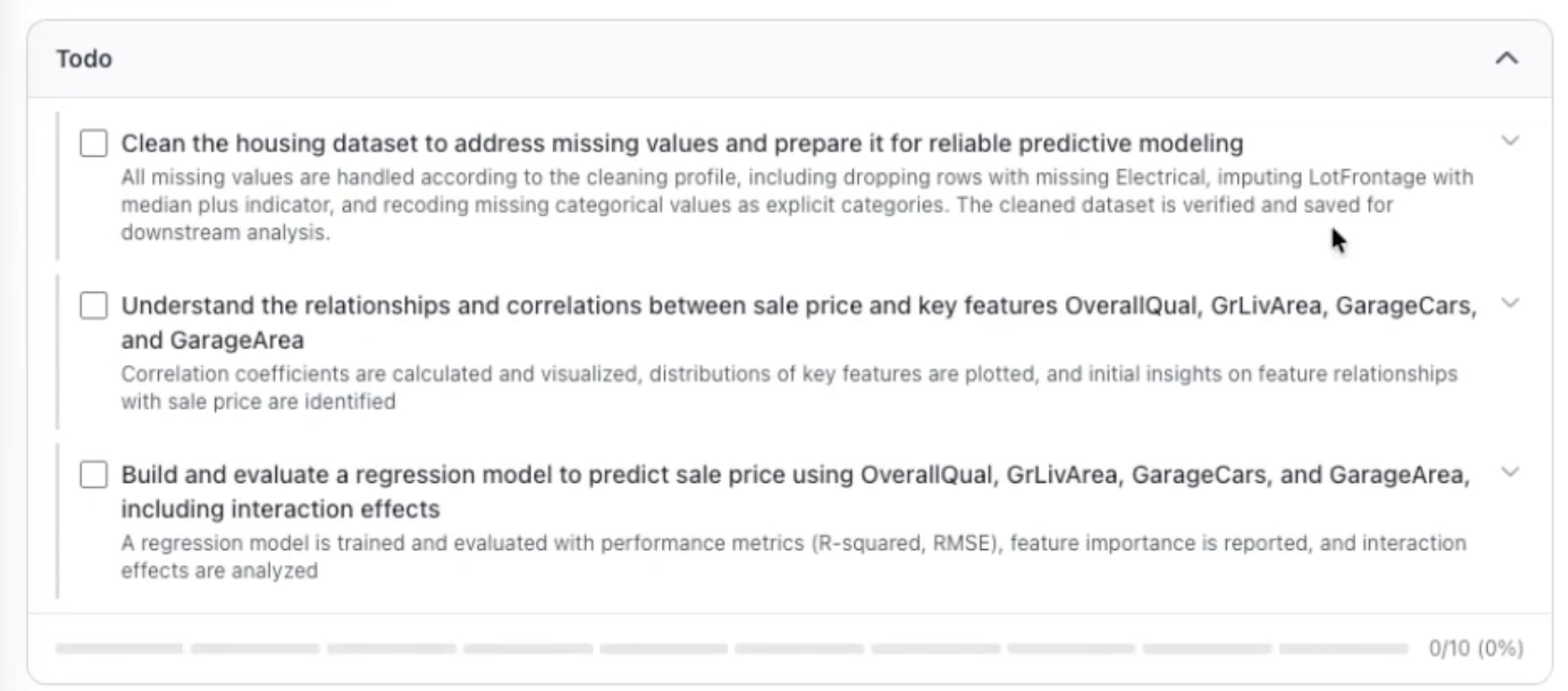
- Planner. Takes a vague user question and produces a structured investigation plan — ordered steps, dependencies, expected outputs.
- Executor. Writes and runs code in a sandboxed environment. Retries on errors, adapts on unexpected outputs.
- Cleaner. Documents every transformation — row counts dropped, imputations, recodings — so the output is auditable.
- Modeler. Picks and runs the appropriate statistical method. Loads domain-specific skills when the data calls for it (GARCH for financial timeseries, FDR correction for genomics, etc.).
- Narrator. Translates the output into business language with explicit caveats and limitations.
- QA. Verifies assumptions, checks for data leakage, flags statistical issues the other agents might have missed.
The Hard Part Isn’t the Model
Most people assume building an AI data agent is about picking the right LLM. It isn’t. The model is roughly interchangeable between GPT, Claude, and newer open-source options. The differentiator is the middleware:
- Orchestration: how you route between agents. Rigid DAGs work for ETL but fail for analysis because each finding changes what you should do next.
- Context management: how you decide what the next agent sees. Too little context and agents lose the thread; too much and they get confused.
- Error recovery: what happens when code fails, data is malformed, or an assumption is wrong. Good agents have a graceful degradation path.
- Tool selection: which statistical method to apply. Generic stats (rolling averages on Bitcoin OHLCV data) miss domain standards (RSI/MACD/Bollinger Bands).
- Prompt engineering: not duct-taping patches onto existing prompts, but refactoring to lean prompts that encode the right mental model.
The biggest threat to a multi-agent system isn’t a lack of intelligence. It’s over-orchestration. Good data analysis cannot be fully planned beforehand — agents need adaptive sub-tasks embedded inside structured DAGs.
Adaptive Planning in Practice
Rigid DAG: planner outputs steps 1, 2, 3; executor runs each in order. Works great for predictable workflows. Breaks when step 1 reveals something that invalidates steps 2 and 3.
Pure chatbot: no DAG at all; every step is a single prompt. Works great for simple questions. Breaks when analysis requires multi-step state management.
The working pattern: structured DAG with adaptive sub-tasks. Top-level plan is stable ("clean, explore, model"), but within each node the agent can iterate and branch based on what it finds. The planner updates the DAG mid-run when data surprises it.
Domain-Specific Skills
Generic statistical toolkits are not enough. Financial timeseries need GARCH volatility models, RSI and MACD momentum indicators, Bollinger Bands — not rolling averages. Clinical trial data needs survival curves, not percentages. Genomics needs FDR correction across 20K genes, not t-tests. Geospatial data needs spatial autocorrelation, not pairwise distance.
A good agent identifies the data domain (how? — LLM inference on schema + column names + data shape) and loads the appropriate statistical library before planning the investigation.
What We Learned Building This
The data analyst prompt in PlotStudio’s system went from 5,778 words (v1) to 14,881 words (peak bloat, v47) back down to 7,441 words (lean rewrite, v53). The journey taught us that prompt bloat is a symptom of wrong architecture, not a solution. You can’t patch your way to a good agent — you have to refactor the mental model the agent operates on.
See an AI data agent in action
Free desktop trial. Runs locally. Watch the full multi-agent workflow live.
Download PlotStudio AI